
|
||||||
|
||||||
How to Calculate the Carbon Footprint of Business Travel23.07.2026
How to Calculate the Carbon Footprint of Business TravelSustainability reporting is no longer relevant only for large corporations. Investors, customers, and regulators now expect companies to measure and report the carbon emissions generated by business travel. But how is the carbon footprint of a flight, a hotel stay, or an airport transfer actually calculated? What Is a Business Travel Carbon Footprint?The business travel carbon footprint is the total greenhouse gas emissions generated by all transportation and accommodation activities during a business trip, expressed as carbon dioxide equivalent (CO₂e). The basic formula is simple: Carbon emissions = Activity data × Emission factor In other words, activity data such as passenger-kilometers for flights, room-nights for hotels, and kilometers traveled by vehicle are multiplied by internationally recognized emission factors, and all results are summed together. In corporate reporting, these emissions are generally reported under GHG Protocol Scope 3 – Category 6: Business Travel. What Is the DEFRA Model? The Global Standard for Emission FactorsThe DEFRA model is a calculation methodology based on the official UK Government GHG Conversion Factors, published annually by the UK government. It is one of the most widely used references in corporate carbon reporting worldwide because the factors are publicly available, updated every year, and cover nearly every aspect of business travel. The DEFRA emission factor set includes separate categories for business travel:
An important advantage of DEFRA is that it also includes WTT (well-to-tank) factors, allowing companies to account not only for fuel combustion but also for emissions generated during fuel production and transportation. This provides a more complete Scope 3 assessment. In practice, the strongest approach is to use ICAO for route- and aircraft-specific flight calculations, while applying DEFRA factors for hotels, transfers, and rail travel. Regardless of the methodology chosen, one rule is essential: the emission factor year must be clearly documented and used consistently from year to year. How Are Flight Emissions Calculated?Flights typically represent the largest share of the carbon footprint in most corporate travel programs. Accurate calculations require the following information:
Business Class passengers are assigned higher emissions because they occupy more cabin space per traveler. One of the most reliable methodologies is the ICAO calculation model, which considers route, aircraft type, and passenger load factor. However, ICAO measures only direct CO₂ emissions and does not include high-altitude climate effects. DEFRA’s flight factors that include radiative forcing fill this gap. Therefore, a transparent report should ideally present two figures:
Hotel Accommodation EmissionsThe formula for hotel emissions is: Number of rooms × Number of nights × Country-specific room-night emission factor. For example, 10 rooms × 3 nights × 25 kg CO₂e equals 750 kg CO₂e. Data quality is critical. If a hotel chain provides verified "kg CO₂e per occupied room-night" values, those should be used instead of national averages. Otherwise, DEFRA’s country-specific hotel factors provide a reliable alternative. Transfer, Vehicle, and Rail EmissionsGround transportation emissions vary depending on vehicle type and fuel:
Two vehicles covering the same distance do not necessarily produce the same emissions, making transport-mode classification essential in business travel reporting. Reliable Carbon Reporting Requires Three LevelsRather than presenting a single "carbon number," organizations should adopt a tiered approach based on data maturity:
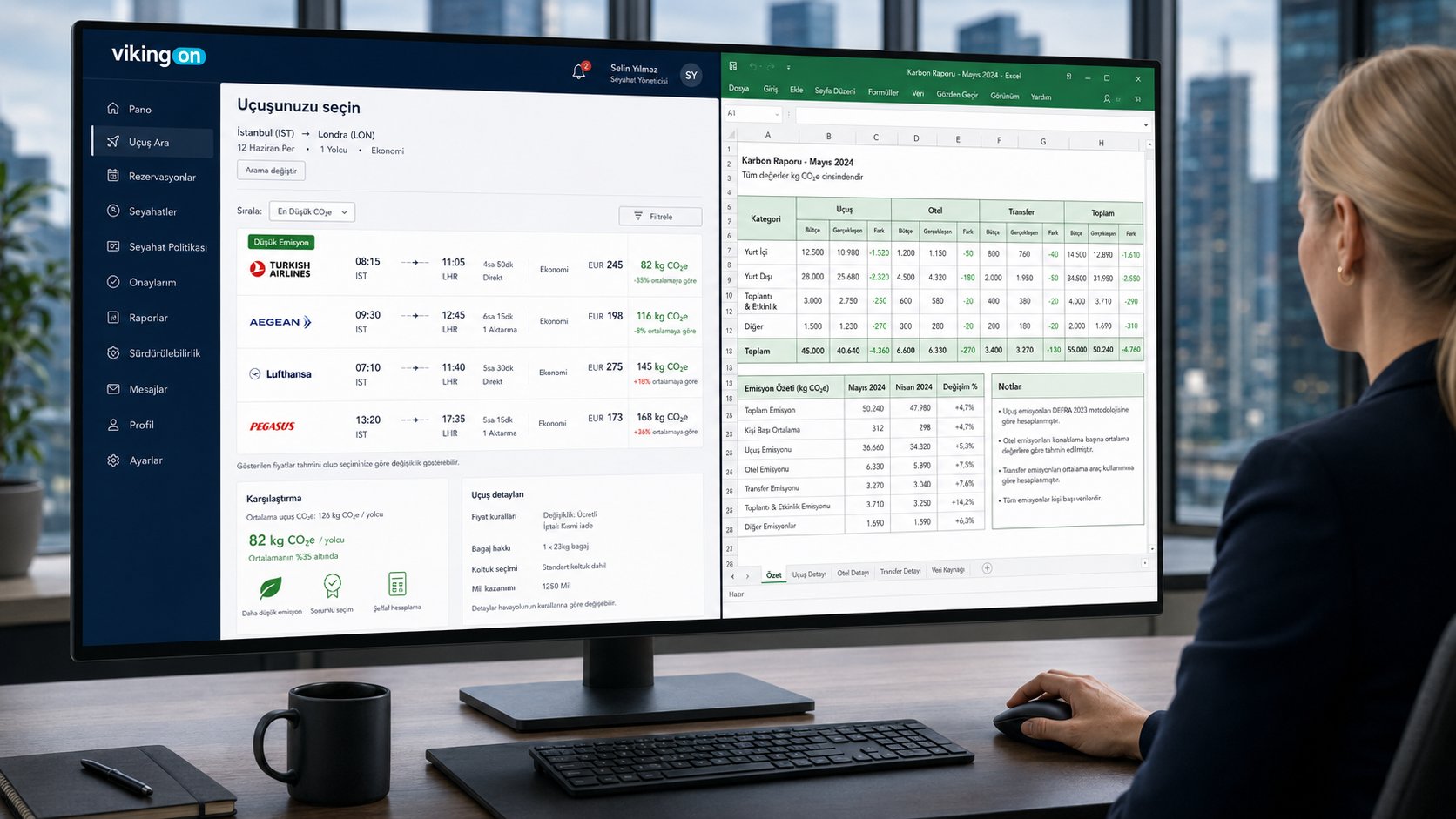
The most common mistake is changing methodologies between reporting periods. This makes year-over-year and route comparisons impossible. One methodology, one emission factor year, and consistent calculation rules are the foundation of reliable reporting. Carbon Reporting with Viking Tourism: Tell Us What You Need, and We’ll Calculate It TogetherWith more than 40 years of experience in corporate travel management, Viking Tourism helps companies make their travel-related carbon emissions measurable and reportable. Our approach is straightforward: share your travel reports and reporting criteria, and we will build your calculations using recognized methodologies such as ICAO and DEFRA. We match every reservation with passenger, department, project code, route, cabin class, and accommodation details to produce consistent reports covering flight, hotel, and transfer emissions. Our Carbon Calculation Tool and VikingOn platform structure this information from the moment of booking. [Suggested link: Carbon Calculation Tool page] [Suggested link: VikingOn page] Our digital tools simplify the process, but they are supported by an experienced team at every step. Carbon reporting is not only about calculations—it also depends on selecting the right methodology and maintaining high-quality data. Measuring the carbon footprint of business travel is a process every company can manage with accurate data and a consistent methodology. Combining ICAO for flights with DEFRA factors for hotels, transfers, and rail travel, while using a fixed emission factor year, creates a solid foundation for both Scope 3 compliance and sustainability goals. Viking Tourism supports you from raw travel data to report-ready carbon reporting. Share your reports and reporting criteria, and let’s build your system together. Contact us for more information: vikingturizm.com.tr/iletisim |
||||||
|
T: +90 212 334 26 26 / F: +90 212 334 26 60 Huzur Mah. Fazıl Kaftanoğlu Cad. No: 9, Kat: 3 34396 Sarıyer / İstanbul / Türkiye www.vikingturizm.com.tr / info@vikingturizm.com.tr |
||||||
|


