
|
||||||
|
||||||
Duty of Care in Business Travel: Company Responsibilities30.07.2026
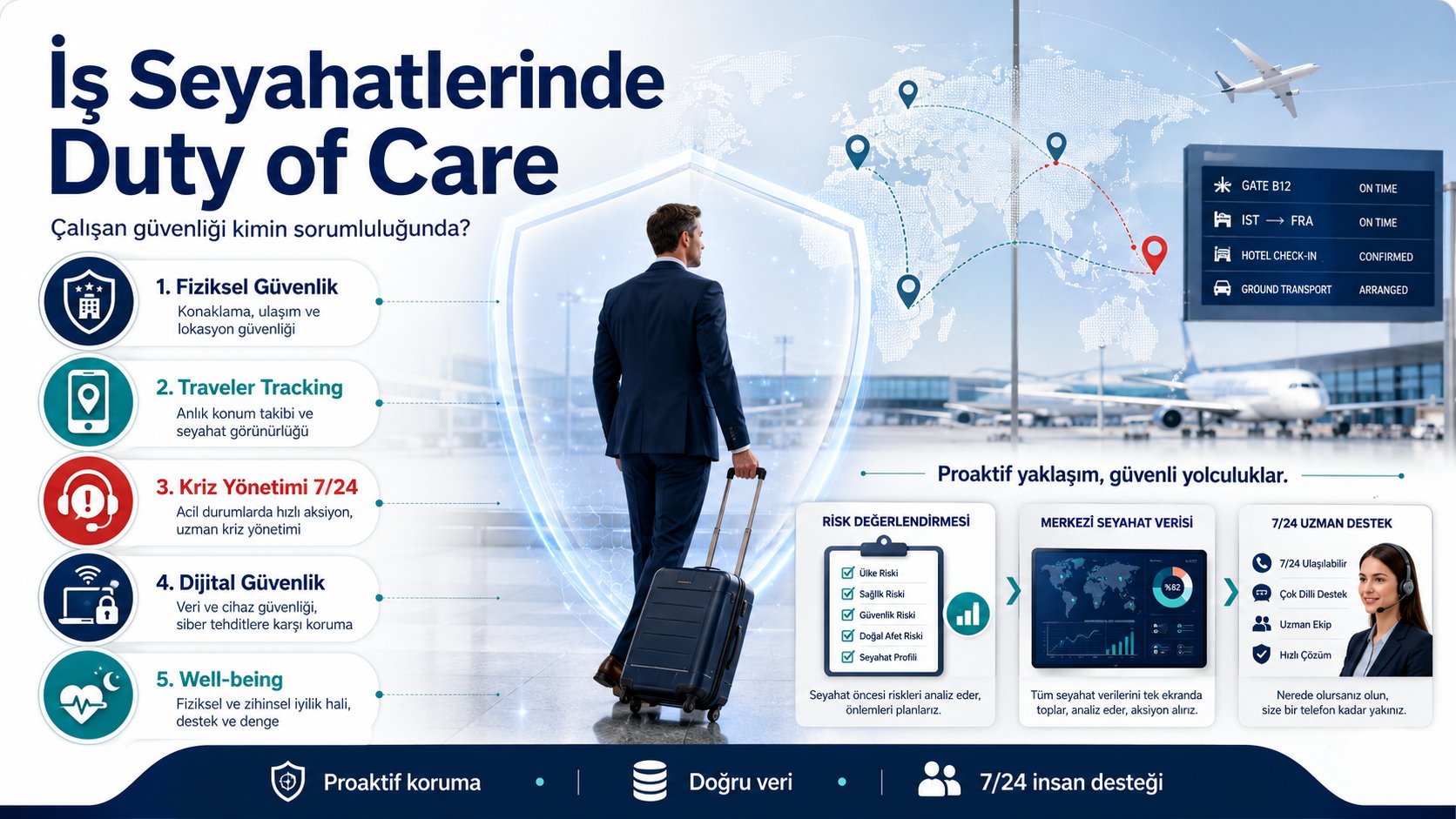
Duty of Care in Business Travel: Who Is Responsible for Employee Safety?Duty of Care is the legal and ethical responsibility of a company to protect the safety, health, and well-being of its traveling employees. In today’s era of "polycrisis," where geopolitical tensions, extreme weather events, and digital threats intersect, this concept has evolved from a simple HR checklist into a strategic People Risk Management discipline. So, what does Duty of Care cover in modern business travel management, and how can companies fulfill this responsibility effectively? What Are a Company’s Responsibilities Under Duty of Care?To fully meet its Duty of Care obligations within a corporate travel policy, a company should focus on five key areas:
When these five areas are addressed together, Duty of Care becomes not just a crisis response capability, but a proactive security framework designed to prevent crises before they occur. From Reactive to Proactive: What Effective Crisis Management Looks LikeThe real difference in Duty of Care is not how quickly a company reacts after a problem occurs, but how effectively it anticipates risks beforehand. A reactive approach comes into play after an employee encounters a crisis. A proactive approach identifies and addresses risks while the trip is still being planned. Three essential elements make this possible:
In short, proactive protection results from the combination of thorough planning, accurate data, and an experienced team that is always available. ISO 31030 and Regulatory ComplianceCompliance with the global ISO 31030 (Travel Risk Management) guidelines significantly reduces a company’s legal exposure. Documenting the risk assessment for every trip makes it much easier to demonstrate that the company has fulfilled its Duty of Care obligations in the event of legal review. This provides tangible protection for both compliance and corporate reputation. Viking Tourism’s ApproachAt Viking Tourism, with over 40 years of experience in corporate travel management since 1984, we treat Duty of Care not as an obligation, but as a standard. Our VikingOn platform centralizes travel planning, approval workflows, and travel data, making it possible to quickly identify where every employee is during an emergency. However, our real differentiator is not just technology: Our digital tools simplify the process, but they are backed by an experienced team that is always ready to act. During a crisis, our 24/7 specialists transform data into action, reach your employees, and arrange alternative solutions within minutes. As a travel management company that combines technology, operations, finance, and human support under one roof, we manage Duty of Care from end to end. Today, Duty of Care is no longer just a legal obligation; it is a leadership vision that strengthens employee engagement and protects corporate reputation. Companies that combine a strong travel policy with people-centered crisis management achieve both cost efficiency and maximum safety throughout their business travel operations. The right question is no longer, "What do we do if something happens?" but rather, "How do we prepare before anything happens?" Contact us for more information: vikingturizm.com.tr/en/contact-us | 0850 281 VIKI |
||||||
|
T: +90 212 334 26 26 / F: +90 212 334 26 60 Huzur Mah. Fazıl Kaftanoğlu Cad. No: 9, Kat: 3 34396 Sarıyer / İstanbul / Türkiye www.vikingturizm.com.tr / info@vikingturizm.com.tr |
||||||
|


